Posts

Showing posts with the label ARPU

LATAM 2009: A Mosaic of Opportunities
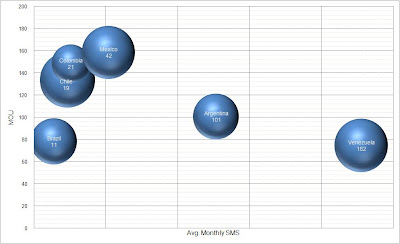
Image
"When we long for life without difficulties, remind us that oaks grow strong in contrary winds and diamonds are made under pressure." ~Peter Marshall Technology companies tend to view the Latin American mobile market as a single block; this might be in part because of the similarities in key demographic and economic factors including language, GDP and mobile penetration as well as the presence of two large players -Telefonica and America Movil- that dominate the region. The Latin American mobile market, however, is incredibly complex. Each country shows remarkably different subscriber usage behavior patterns and adoption of technologies; this translates into different needs and consequently, different opportunities for each market. Opportunity Maps are particularly useful in analyzing and understanding these differences. The chart above shows three key factors: (x) Average Monthly SMS; (y) MOU - Minutes of Usage; and ARPU - Monthly Average Revenue per User (bubble size) for t...

Five top predictions for the Latin American Mobile Market in 2009

Image
"Profits are an opinion, cash is a fact." For my first post of the year, I will share my thoughts on what to expect for 2009, based on the economic outlook, industry trends and user behavior. So without further ado, here are my top five predictions for 2009 for the Latin America Mobile market: Growth will continue but at a slower rate than previously expected: Mr. José María Álvarez Pallete, General Manager of Telefónica Latinoamérica, stated last year that the region will continue to grow in subscribers and revenues, but given the economic crisis, it will be at a slower growth rate than previously expected. The 2008 economic downturn will very likely be the main factor affecting operator decisions. Mobile operators will be watching CAPEX spending closely and will be looking for ways to reduce OPEX spending in every way possible. They will be more interested in Value Added Services that can be deployed to the mass market, across a broad range of devices and that can be offe...

Why Voice Mail vendors should pay more attention to Voice to Text services - part 2

This is a follow up to my last post about the relevance of Voice to Text for Voice Mail vendors. One of the main challenges operators face when introducing new value added services to their offering is defining the target segment and making sure these services will attract a large enough group of subscribers. A compelling business case is not the only factor that operators will use to determine whether or not to launch a new service. However, VAS managers are under increased pressure to raise ARPU and the effort required to launch new services will hardly be worth their time if they cannot show a significant contribution to the bottom line. At first glance, the business case for voice to text delivery of voice mail messages may seem difficult, in particular for Tier 2 and Tier X operators. The cost of transfering messages -mainly because of costs associated to ensuring the quality of transcription- makes it seem that this is a service that can only be offered to specific segments, such...

Microsoft Starts Placing Ads on Cell Phone Portal MSN Mobile

From Cellular News and other news sources, we find out that Microsoft has started placing advertisements on the U.S. version of MSN Mobile. Microsoft already serves up mobile ads in Japan and some European markets. Competitor Yahoo began selling cell phone ads phones in the U.S. in late 2006 and expanded overseas in February (source: Cellular News ). What about Latin America? Microsoft introduced MSN Mobile in the Latin American market in 2006, with Brazil leading the way ( source ), as well as Movistar Chile and Argentina, with the launch of MSN Mobile ( source ). While this service is available in most of the region, it is a WAP based service that can be cumbersome. There are no available statistics that we know of for the penetration of this service, but we expect them to be very low. The deployment of 3G networks in the region can probably help operators provide a better user experience for this service, although given the limitations presented by a mostly prepaid customer base (~...