Posts

Showing posts with the label GSMA

LATAM 2009: A Mosaic of Opportunities
Image
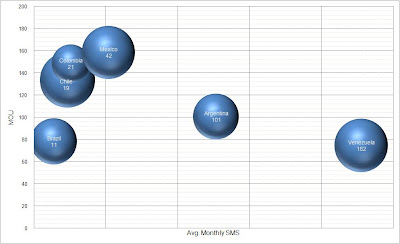
"When we long for life without difficulties, remind us that oaks grow strong in contrary winds and diamonds are made under pressure." ~Peter Marshall Technology companies tend to view the Latin American mobile market as a single block; this might be in part because of the similarities in key demographic and economic factors including language, GDP and mobile penetration as well as the presence of two large players -Telefonica and America Movil- that dominate the region. The Latin American mobile market, however, is incredibly complex. Each country shows remarkably different subscriber usage behavior patterns and adoption of technologies; this translates into different needs and consequently, different opportunities for each market. Opportunity Maps are particularly useful in analyzing and understanding these differences. The chart above shows three key factors: (x) Average Monthly SMS; (y) MOU - Minutes of Usage; and ARPU - Monthly Average Revenue per User (bubble size) for t...

VAS Latin America: Finding Opportunities in a year of Economic Uncertainty

"Nothing is more expensive than a missed opportunity." -H. Jackson Brown Jr.: Participants at the Mobile World Congress in Barcelona this week got a chance to discuss new and exciting trends in mobile services like Location Based Services, Mobile Entertainment, Mobile Advertising and Advanced Messaging services. However, the single topic that stole the show is the economic uncertainty that mobile operators and technology companies are facing. The keynote conference that opened the congress on Tuesday says it all: " Sustaining Growth in Challenging Times "(1). No one can argue that these are tough times but doing nothing seems to be the current modus operandi of the industry. My friend Mark Pendergast referred to me a great article by Professor John A. Quelch of Harvard " Marketing Your Way Through a Recession ". Published almost a year ago, it is even more relevant today: "In a recession, consumers become value oriented, distributors are concerned ab...

Mobile World Congress 2009: What does one wear to a recession?

Image
Sad In Blue (a lyric) by Peter S. Quinn Sad sad sad in blue For sad sad sad you The moon is all bluish tonight The night is all dark out side. So what does one wear to a recession? It doesn't really matter as long as you show up! This week technology vendors and operators meet at the Mobile World Congress in Barcelona and designers get to show their collections at Fashion Week in New York City. Both events might not seem to have much in common, but one topic is grabbing headlines at both: the economic downturn. At Fashion Week this year the events are less festive than usual; journalists and fashion bloggers are noticing: " Fashion Weak: Where has all the glamour gone? " (New York Post); " Fashionistas have turned into recessionistas " (USA Today). According to Christopher Muther of the Boston Globe , "there are fewer gift bags for fashion buyers and editors, and the steady stream of opulent parties has slowed to a trickle. Instead of pricey runway shows,...

Will 2009 be the year for Mobile Instant Messaging in Latin America?

Image
Subscriber usage behavior clearly shows that the Latin American market is ready for a solution such as GSMA Personal IM, also known as SMS 2.0 (Telefonica Spain, Acision) or Instant SMS (Comverse). The chart above measures three elements: Data ARPU (x), mobile penetration (y) and average number of SMS messages per user per month for several Latin American countries (1) . The countries with SMS usage in the region are Venezuela, Argentina and Ecuador; with Colombia having the lowest SMS usage. These countries also have a higher data ARPU; this is not surprising as in Latin America 70% to 90% of data revenue comes from SMS. What's relevant here is subscriber SMS usage, surpassing 100 messages per user per month as in the case of Venezuela and more recently Argentina; this tells us that heavy users are actually having live conversations using SMS; in other words, a segment of subscribers uses SMS as Instant Messaging, with a higher number of messages going back and forth per conversa...

The time has come, to talk of many things: SMS 2.0, Personal IM and Instant SMS

Image
The time has come for SMS 2.0? In the last three years, we have seen vendors introduce new messaging solutions, all claiming to be the next step in SMS evolution. Presence enabled services have received a lot of attention but have limited traction in the mobile market. IM, by no means a new service, has been one of the most successful services but still far behind the penetration SMS has. SMS reached a mature stage years ago, its growth rate has flattened and it has kept the same form and functionality since it was first introduced. However, it remains one the top revenue generator for mobile operators. So what do you do for an encore? Cellular News published an interesting note on February 2nd: "­Acision has announced that Russian mobile operator, MTS is using its Instant Messaging solution to offer an enhanced messaging experience to its subscribers. Combining the Acision Person to Person Gateway with core elements from Colibria's product portfolio - including the Instant M...

Rethinking Opportunities for the Latin American Mobile Market in 2009

During the last quarter of 2008, as they finalized budgets and CAPEX allocation for the coming year, operators around the world were forced to take a second look at their growth expectations and make drastic changes to their 2009 plans. Operators are preparing to face the economic downturn with layoffs and by reducing CAPEX and OPEX and vendors are reacting to these measures and to the economic environment in a similar way. The question that needs to be asked, however, is how will operators and vendors rethink opportunities for 2009? The economic downturn will force operators to be even more cautious with service rollouts and new investments (see Millicom , Telefonica ). There is no question that their priorities this year will focus on: Improving productivity Reducing OPEX Rollout of new services with minimal CAPEX and faster ROI. These guidelines provide a framework for rethinking VAS strategies and opportunities for 2009: Increasing voice revenues - Even if the economic downturn af...

Telecom Argentina - does SMS success reflect missed opportunities? PART 2

Image
This is a follow up to my recent post on a Cellular News article about the success of Telecom Argentina has had increasing SMS usage. I stated that this might indicate the need to pay more attention to other messaging services such as MMS, Instant Messaging, Personal Messaging as well as other data services. From the usage statistics we have from Pyramid Research (March 2008), we can see that SMS revenue for the Argentinean market represents more than 85% of total messaging revenues. While this is expected to change over time, the numbers we have clearly reflect that SMS is still the main source of revenue from messaging. In early 2007, Telecom Personal launched an initiative to evaluate Mobile Instant Messaging, following Telefonica Movistar's agreement with MSN, which was discussed in this blog (see here ). Telecom Personal went through the process of issuing an RFP and evaluating and selecting a vendor but in the end decided not to launch the service. I believe that was a missed...

VAS Marketing: Improving the User Interface to drive revenue

Image
Voice Mail and SMS have been in a mature stage for several years now; growth in most markets has slowed down and until recently, they kept the same form and functionality they had since they were first introduced years ago. Both services, however, remain the bread and butter of VAS services. In most markets (the USA being a notable exception) Voice Mail is the largest VAS contributor to revenue for mobile operators; SMS in some cases accounts for up to 90% of data revenue. This alone justifies paying attention to recent developments that are breathing new life into these two services by dramatically improving the user experience with visual interfaces. The best example of this is the iPhone, which introduced to the market visual applications for both services. Visual Voice Mail had been around for several years, but it was not until the iPhone was introduced that it got the attention of mobile operators. While it can be argued that the iPhone reflects a shift in users’ expectations as ...

Brazil Operators fast forward PART II

The initiative by Brazilian Operators together with GSMA is groundbreaking in Latin America, not only because of the imminent launch of Personal Instant Messaging in the region with all six operators offering interconnection but also for the fact that these operators are sitting together in a work group to define a product, evaluate vendors and complete a through study before launch. We expect that this will delay even more the launch of the service, which has been evaluated by operators like TIM, VIVO and Claro for at least two years now. However, the approach of this work group, led by Ms Paloma Vivanco of GSMA, will increase the likelihood of a succesful launch and service penetration. The work group met recently in Rio to discuss with different vendors their solutions. Among the vendors presenting were market leaders Acision, Colibira and Comverse, as well as an up and coming Uruguayan company, INI. The only other big IM vendor that always seems to be absent from Latin America init...

Brazil Operators fast forward with Personal Instant Messaging

As reported previously here (see here , here and here ), six major Brazilian Operators have come together to launch Personal IM and build an operator led mobile IM community in the Brazilian market by Q2 08. Participating operators are Vivo, Claro, Oi, Brasil Telecom, Telemig Amazonia, TIM. These operators are working together with Paloma Vivanco, Market Development Manager for Personal IM of the GSM Association. With this, Brazil leads the effort for deploying Personal Instant Messaging in Latin America. Other efforts include Telefonica Movistar. We have not heard yet from the largest operator in the region, Telcel (Mexico), but surely after this announcement, they will pay close attention to this service which has already been successfully deployed in Europe and Asia.

Brazil operators pushing GSMA Personal Messenger concept

It appears that operators in Brazil are taking the lead now in deploying Personal Instant Messaging , following GSM Association's technical and commercial framework, which has already been deployed by other operators in Europe and Asia. The most interesting aspect of the efforts done by the largest operators in Brazil, including TIM, Oi, Claro and Vivo is adopting the framework proposed by GSMA, which allows interconnection. Other operators in Europe and Asia are already working with this framework, where interconnection is a key element. Even though operators in Brazil are still in initial stages, in discussions with different vendors, it appears that 2008 will be the year for Personal Instant Messaging in Latin America.

Instant Messaging: Personal IM VS Portal IM

Given MSN's slow approach to developing the MIM market in Latin America, it will be interesting tosee if Telefonica's strategy of repackaging Personal IM as SMS 2.0 -like they are doing in Spain- will work in Latin America.It is no secret that operators in Latin America have triedfor several years to sign an agreement with MSN for Mobile Instant Messaging with no success. Until 2006, only Movistar Chile and Argentina were able to sign such an agreement and that was for a WAP based solution.GSMA is developing an open solution, with interconnection between operators . In Europe operators have already deployed such a solution, this seems like an appropriate strategy for the Latin American market.GSMA has also stated that it eventually wants to have interconnectivity with portals. This makes us wonder how long can MSN stand the pressure? With two huge groups, Telefonica and America Movil, dominating the landscape in one of the fastest growing mobile markets, it shouldn't be d...

Update: Personal Instant Messaging Services in Latin America

About a month ago, GSM Association issued a press release announcing Personal Instant Messaging Services Go Live in Asia with the commercial launch of IM in India (Aircel, Bharti Airtel, BPL Mobile, BSNL, Idea, MTNL, Reliance Telecom, Spice and Vodafone-Essar) and Malaysia (DiGi Telecommunications and Maxis), which allows customers of those networks to send each other instant messages using their mobile phones. According to GSMA, more than 40 mobile operators worldwide are developing Personal IM services. This initiative has taken root in Latin America with Telefonica Movistar leading the way with their SMS 2.0 initiative. SMS 2.0 is Telefonica's commercial name for the same service, which GSMA calls Personal Instant Messaging. GSMA has been working hard for the last two years to support the development of the technical and commercial framework for this service. In Latin America, Telefonica Movistar is already looking into deploying this service in different operations. Brazil ope...