Posts

Showing posts with the label millicom

LATAM 2009: A Mosaic of Opportunities
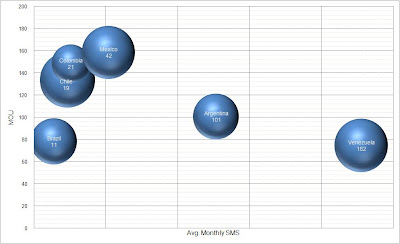
Image
"When we long for life without difficulties, remind us that oaks grow strong in contrary winds and diamonds are made under pressure." ~Peter Marshall Technology companies tend to view the Latin American mobile market as a single block; this might be in part because of the similarities in key demographic and economic factors including language, GDP and mobile penetration as well as the presence of two large players -Telefonica and America Movil- that dominate the region. The Latin American mobile market, however, is incredibly complex. Each country shows remarkably different subscriber usage behavior patterns and adoption of technologies; this translates into different needs and consequently, different opportunities for each market. Opportunity Maps are particularly useful in analyzing and understanding these differences. The chart above shows three key factors: (x) Average Monthly SMS; (y) MOU - Minutes of Usage; and ARPU - Monthly Average Revenue per User (bubble size) for t...

LATAM 2009 Update - Slower Growth and Intense Competition

"Out of suffering comes creativity. You cannot spell painting without pain." John Lithgow in Third Rock From the Sun Halfway through the first quarter of the year, the outlook for the economy continues to deteriorate with operators and technology vendors facing reduced CAPEX, delayed investments and slower growth rates. LATINFOCUS (January 2009) expects Latin America to grow at the slowest pace in seven years; industry analysts estimate wireless subscriber growth in 2009 to be between 5% (Yankee Group) and 8% (Moody's), down from double digit growth in previous years ( Reinhardt Krause , Investor's Business Daily). Moody's analyst Nymia Almeida ( Reinhardt Krause , Investor's Business Daily) states that operators like America Movil still expect a 10% subscriber growth but with mobile penetration reaching saturation in major markets and slower growth rates this year, the only way they can achieve this is via churn from other operators. What can operators do in...

Rethinking Opportunities for the Latin American Mobile Market in 2009

During the last quarter of 2008, as they finalized budgets and CAPEX allocation for the coming year, operators around the world were forced to take a second look at their growth expectations and make drastic changes to their 2009 plans. Operators are preparing to face the economic downturn with layoffs and by reducing CAPEX and OPEX and vendors are reacting to these measures and to the economic environment in a similar way. The question that needs to be asked, however, is how will operators and vendors rethink opportunities for 2009? The economic downturn will force operators to be even more cautious with service rollouts and new investments (see Millicom , Telefonica ). There is no question that their priorities this year will focus on: Improving productivity Reducing OPEX Rollout of new services with minimal CAPEX and faster ROI. These guidelines provide a framework for rethinking VAS strategies and opportunities for 2009: Increasing voice revenues - Even if the economic downturn af...

Five top predictions for the Latin American Mobile Market in 2009

Image
"Profits are an opinion, cash is a fact." For my first post of the year, I will share my thoughts on what to expect for 2009, based on the economic outlook, industry trends and user behavior. So without further ado, here are my top five predictions for 2009 for the Latin America Mobile market: Growth will continue but at a slower rate than previously expected: Mr. José María Álvarez Pallete, General Manager of Telefónica Latinoamérica, stated last year that the region will continue to grow in subscribers and revenues, but given the economic crisis, it will be at a slower growth rate than previously expected. The 2008 economic downturn will very likely be the main factor affecting operator decisions. Mobile operators will be watching CAPEX spending closely and will be looking for ways to reduce OPEX spending in every way possible. They will be more interested in Value Added Services that can be deployed to the mass market, across a broad range of devices and that can be offe...

VAS Latin America: hits and misses of 2008

Image
As the year comes to an end, it's a good idea to reflect on the past and learn from our experience, good or bad. With this in mind, I compiled a list of the good, the bad and the really bad news and analysis from the mobile industry in Latin America that I blogged about during 2008, with some additional comments and reflections. Enjoy! The good!!!! America Movil launches the iPhone - after much speculation and anticipation, America Movil formally announced in early May that they were selected to distribute the iPhone in Latin America. America Movil's VAS team moved quickly and successfully launched exactly one year after the iPhone was first launched in the USA by AT&T. Why is this GOOD? This was a complex deployment that was done with a very tight schedule. The successful launch of the iPhone in Latin America was possible thanks to a strong team; Corporate VAS in Mexico, together with local VAS Managers and Operations Managers in the region showed that they have wha...

Even in an economic downturn deprovision is NOT the solution

Even before the economic meltdown, in the last three years operators operators worldwide were developing more aggressive business case guidelines for new and existing services. Operators such as Telefonica, Vodafone and Millicom today have imposed business case guidelines that are more strict than ever before. To comply, VAS managers have followed the strategy of evaluating subscribers and deprovisioning services from low usage segments. We have seen this happen over and over again with operators in Europe, Latin America and Asia. Deprovisioning subscribers from low usage segments looks good on paper because it makes it seem that operators are serving the same or even a larger subscriber base with lower CAPEX. The problem with this is that operators are playing with financial formulas instead of increasing revenues. In addition, many times operators do not provide an alternative service for these segments. While new models for commercial agreements that are not based on a per subscrib...

VAS Opportunties in a Downturn Economy: Repackaging traditional services

The current world recession is leading businesses and consumers to curtail spending, which is expected to affect growth and revenues during 2009. Every day we hear about how operators are preparing to face this economic downturn with layoffs and by reducing CAPEX and OPEX; just last week, AT&T announced plans to cut 4% of its work force ( Cellular News ); Sprint Nextel is also expected to announce job cuts in 2009 ( Cellular News ). In Latin America, Millicom recently announced that 2009 CAPEX will be “substantially lower” than in 2008 and Telefonica stated last week that the region will continue to grow, but at a slower rate than previously expected. Despite the current economic downturn, there are opportunities operators have to introduce new services with minimal CAPEX. By analyzing end user behavior, traditional services such as Voice Mail, SMS and MMS can be repackaged and launched as new services, leveraging existing VAS infrastructure and reducing CAPEX normally required f...

Millicom: a DIFERENT approach to DIFFERENTIATION

Image
We recently posted about Millicom's success in Latin America, where it is positioned as a reliable operator with strong customer loyalty. The Latin American market continues to grow and Millicom is benefitting from this, but it has also managed to gain market share from the two giants in the region, America Movil and Telefonica Movistar. The question is how is Millicom doing this? Both heavyweights have consolidated their leadership in Latin America; they compete head to head in most of the region (America Movil operates in 16 countries, Telefonica Movistar in 13) and both surpassed the 100 million mark a couple of years ago. Both operators seem intent to compete by continually trying to differentiate themselves with new products and services. However, in most cases, it only takes a few months for the other to catch up. Most recently, both operators were ready to kill each other over the iPhone. America Movil got a headstart but in the end, Telefonica was able to mitigate any possi...

What to expect for 2009 - Jose Maria Alvarez Pallete, Telefonica

We recently posted our thoughts on remarks made by Marc Beuls, President and CEO of Millicom, at the Morgan Stanley 8th Annual Technology, Media and Telecoms Conference in Barcelona. Even though Millicom continues its impressive growth in Latin America, Mr. Beuls made it clear that that CAPEX for 2009 will be “substantially lower” than in 2008. It comes as no surprise that other major players in the region will follow a similar strategy in 2009. Mr. José María Álvarez Pallete, General Manager of Telefónica Latinoamérica, stated last week at CEDE (V Congreso de la Confederación Española de Directivos y Ejecutivos) that the region will continue growing in subscribers and revenues (source Telesemana ), but he expects a slowdown in 2009, given the economic crisis. Mr. Álvarez Pallete, however, made it clear that this won't be a dramatic slowdown but rather a slower growth rate than previously expected and that Latin America is the area where the company expects to grow in the coming y...

What to expect from the Latin American Mobile Market in 2009

As mobile operators finish completion of their budgets for 2009 and approach the holiday season, vendors anxiously await what will be one of the toughest years since the telecom downturn from the late 90's/2000. An interesting insight into what to expect for 2009 comes from Marc Beuls, President and CEO of Millicom, who presented to investors at the Morgan Stanley 8th Annual Technology, Media and Telecoms Conference in Barcelona just a week ago. Mr Beuls’ presentation has been posted on Millicom’s website at www.millicom.com and includes updated information on expected capital expenditures, cashflow and margins (see press release here ). Millicom continues its impressive growth with outstanding results; it reports a 71% in Honduras from Q3 07, 39% in Guatemala and 29% in El Salvador. Millicom operates in Latin American markets that are still growing but has gained market share from its main competitors in Central America, America Movil and Telefonica Movistar. Millicom is now the ...