Posts

Showing posts with the label telefonica movistar

MWC 2019

#MWC19 starting in one hour pic.twitter.com/nOx6JSWaWx — Raul Castañon (@rcastanonm) February 25, 2019 Excited to attend MWC for the fifth time. A lot of briefings lined up including Samsung, VMware, Tango Networks, Ericsson, Huawei, Telefonica, Polycom, Ribbon Communications, Infobip, Tata Communications, Twilio, Buddy Platform ... too many to list. I'll be publishing a spotlight report on the event and company impact reports from my different briefings. Also proud to be judge for the MWC Glomo Awards for the fifth time. A lot of work ahead this week but very happy to be back in beautiful Barcelona.
LATAM 2009: A Mosaic of Opportunities

Image
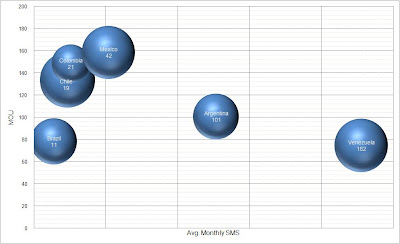
"When we long for life without difficulties, remind us that oaks grow strong in contrary winds and diamonds are made under pressure." ~Peter Marshall Technology companies tend to view the Latin American mobile market as a single block; this might be in part because of the similarities in key demographic and economic factors including language, GDP and mobile penetration as well as the presence of two large players -Telefonica and America Movil- that dominate the region. The Latin American mobile market, however, is incredibly complex. Each country shows remarkably different subscriber usage behavior patterns and adoption of technologies; this translates into different needs and consequently, different opportunities for each market. Opportunity Maps are particularly useful in analyzing and understanding these differences. The chart above shows three key factors: (x) Average Monthly SMS; (y) MOU - Minutes of Usage; and ARPU - Monthly Average Revenue per User (bubble size) for t...

LATAM 2009 Update - Slower Growth and Intense Competition

"Out of suffering comes creativity. You cannot spell painting without pain." John Lithgow in Third Rock From the Sun Halfway through the first quarter of the year, the outlook for the economy continues to deteriorate with operators and technology vendors facing reduced CAPEX, delayed investments and slower growth rates. LATINFOCUS (January 2009) expects Latin America to grow at the slowest pace in seven years; industry analysts estimate wireless subscriber growth in 2009 to be between 5% (Yankee Group) and 8% (Moody's), down from double digit growth in previous years ( Reinhardt Krause , Investor's Business Daily). Moody's analyst Nymia Almeida ( Reinhardt Krause , Investor's Business Daily) states that operators like America Movil still expect a 10% subscriber growth but with mobile penetration reaching saturation in major markets and slower growth rates this year, the only way they can achieve this is via churn from other operators. What can operators do in...

Voice Mail Strategy Chile

Check out this SlideShare Presentation: Voice Mail Strategy Chile View more presentations from Raul Castanon . (tags: voice mail )

Mobile Analytics - get started NOW

Image
"Measure what is measurable, and make measurable what is not so.” -Galileo Galilei The intersection of the mobile space and the Internet continues to be a challenge for mobile operators. Mobile advertising, for example, is getting a lot of attention in the mobile industry but it has yet to consolidate as a significant revenue generator (see Mobile Advertising - Learning to play by the rules ). Internet marketing and Web analytics have come a long way in the last five years, but there is still a long way to go in the mobile space. Interestingly, mobile operators are actually very good with metrics, when it comes to voice. They have precise indicators to evaluate network productivity, performance and utilization as well as detailed demographic and psychographic user data. However, when it comes to Web analytics, mobile operators have not even started exploring its potential. Even in the USA, operators lag behind other industries such as finance and retail. Other regions such as La...

Repackage, Reposition, Reinvent VAS services in 2009

"Nothing is more expensive than a missed opportunity." -H. Jackson Brown Jr. This is a follow up to my two previous posts where I discussed opportunities and my top five predictions for the Latin America mobile market in 2009. The global economic downturn has forced operators to take a second look at new investments for 2009; however, this can be a good opportunity to look at things differently. Operators can rethink their VAS strategy and Repackage, Reposition, and Reinvent services and adapt to succed in the new economic environment. What follows is a list of services that, based on my experience, have a higher probability for success in 2009-2010: Reinvent voice .... Operators will be watching CAPEX spending closely and looking for ways to reduce OPEX. In addition, voice will continue to be the greatest cash generator in the region through 2013; it therefore makes sense to think about services that will help them offer voice services as cost-effectively as possible. ... ...

Rethinking Opportunities for the Latin American Mobile Market in 2009

During the last quarter of 2008, as they finalized budgets and CAPEX allocation for the coming year, operators around the world were forced to take a second look at their growth expectations and make drastic changes to their 2009 plans. Operators are preparing to face the economic downturn with layoffs and by reducing CAPEX and OPEX and vendors are reacting to these measures and to the economic environment in a similar way. The question that needs to be asked, however, is how will operators and vendors rethink opportunities for 2009? The economic downturn will force operators to be even more cautious with service rollouts and new investments (see Millicom , Telefonica ). There is no question that their priorities this year will focus on: Improving productivity Reducing OPEX Rollout of new services with minimal CAPEX and faster ROI. These guidelines provide a framework for rethinking VAS strategies and opportunities for 2009: Increasing voice revenues - Even if the economic downturn af...

Five top predictions for the Latin American Mobile Market in 2009

Image
"Profits are an opinion, cash is a fact." For my first post of the year, I will share my thoughts on what to expect for 2009, based on the economic outlook, industry trends and user behavior. So without further ado, here are my top five predictions for 2009 for the Latin America Mobile market: Growth will continue but at a slower rate than previously expected: Mr. José María Álvarez Pallete, General Manager of Telefónica Latinoamérica, stated last year that the region will continue to grow in subscribers and revenues, but given the economic crisis, it will be at a slower growth rate than previously expected. The 2008 economic downturn will very likely be the main factor affecting operator decisions. Mobile operators will be watching CAPEX spending closely and will be looking for ways to reduce OPEX spending in every way possible. They will be more interested in Value Added Services that can be deployed to the mass market, across a broad range of devices and that can be offe...

VAS Latin America: hits and misses of 2008

Image
As the year comes to an end, it's a good idea to reflect on the past and learn from our experience, good or bad. With this in mind, I compiled a list of the good, the bad and the really bad news and analysis from the mobile industry in Latin America that I blogged about during 2008, with some additional comments and reflections. Enjoy! The good!!!! America Movil launches the iPhone - after much speculation and anticipation, America Movil formally announced in early May that they were selected to distribute the iPhone in Latin America. America Movil's VAS team moved quickly and successfully launched exactly one year after the iPhone was first launched in the USA by AT&T. Why is this GOOD? This was a complex deployment that was done with a very tight schedule. The successful launch of the iPhone in Latin America was possible thanks to a strong team; Corporate VAS in Mexico, together with local VAS Managers and Operations Managers in the region showed that they have wha...

Even in an economic downturn deprovision is NOT the solution

Even before the economic meltdown, in the last three years operators operators worldwide were developing more aggressive business case guidelines for new and existing services. Operators such as Telefonica, Vodafone and Millicom today have imposed business case guidelines that are more strict than ever before. To comply, VAS managers have followed the strategy of evaluating subscribers and deprovisioning services from low usage segments. We have seen this happen over and over again with operators in Europe, Latin America and Asia. Deprovisioning subscribers from low usage segments looks good on paper because it makes it seem that operators are serving the same or even a larger subscriber base with lower CAPEX. The problem with this is that operators are playing with financial formulas instead of increasing revenues. In addition, many times operators do not provide an alternative service for these segments. While new models for commercial agreements that are not based on a per subscrib...

VAS Opportunties in a Downturn Economy: Repackaging traditional services

The current world recession is leading businesses and consumers to curtail spending, which is expected to affect growth and revenues during 2009. Every day we hear about how operators are preparing to face this economic downturn with layoffs and by reducing CAPEX and OPEX; just last week, AT&T announced plans to cut 4% of its work force ( Cellular News ); Sprint Nextel is also expected to announce job cuts in 2009 ( Cellular News ). In Latin America, Millicom recently announced that 2009 CAPEX will be “substantially lower” than in 2008 and Telefonica stated last week that the region will continue to grow, but at a slower rate than previously expected. Despite the current economic downturn, there are opportunities operators have to introduce new services with minimal CAPEX. By analyzing end user behavior, traditional services such as Voice Mail, SMS and MMS can be repackaged and launched as new services, leveraging existing VAS infrastructure and reducing CAPEX normally required f...

Millicom: a DIFERENT approach to DIFFERENTIATION

Image
We recently posted about Millicom's success in Latin America, where it is positioned as a reliable operator with strong customer loyalty. The Latin American market continues to grow and Millicom is benefitting from this, but it has also managed to gain market share from the two giants in the region, America Movil and Telefonica Movistar. The question is how is Millicom doing this? Both heavyweights have consolidated their leadership in Latin America; they compete head to head in most of the region (America Movil operates in 16 countries, Telefonica Movistar in 13) and both surpassed the 100 million mark a couple of years ago. Both operators seem intent to compete by continually trying to differentiate themselves with new products and services. However, in most cases, it only takes a few months for the other to catch up. Most recently, both operators were ready to kill each other over the iPhone. America Movil got a headstart but in the end, Telefonica was able to mitigate any possi...

What to expect for 2009 - Jose Maria Alvarez Pallete, Telefonica

We recently posted our thoughts on remarks made by Marc Beuls, President and CEO of Millicom, at the Morgan Stanley 8th Annual Technology, Media and Telecoms Conference in Barcelona. Even though Millicom continues its impressive growth in Latin America, Mr. Beuls made it clear that that CAPEX for 2009 will be “substantially lower” than in 2008. It comes as no surprise that other major players in the region will follow a similar strategy in 2009. Mr. José María Álvarez Pallete, General Manager of Telefónica Latinoamérica, stated last week at CEDE (V Congreso de la Confederación Española de Directivos y Ejecutivos) that the region will continue growing in subscribers and revenues (source Telesemana ), but he expects a slowdown in 2009, given the economic crisis. Mr. Álvarez Pallete, however, made it clear that this won't be a dramatic slowdown but rather a slower growth rate than previously expected and that Latin America is the area where the company expects to grow in the coming y...

Telecom Argentina - does SMS success reflect missed opportunities? PART 2

Image
This is a follow up to my recent post on a Cellular News article about the success of Telecom Argentina has had increasing SMS usage. I stated that this might indicate the need to pay more attention to other messaging services such as MMS, Instant Messaging, Personal Messaging as well as other data services. From the usage statistics we have from Pyramid Research (March 2008), we can see that SMS revenue for the Argentinean market represents more than 85% of total messaging revenues. While this is expected to change over time, the numbers we have clearly reflect that SMS is still the main source of revenue from messaging. In early 2007, Telecom Personal launched an initiative to evaluate Mobile Instant Messaging, following Telefonica Movistar's agreement with MSN, which was discussed in this blog (see here ). Telecom Personal went through the process of issuing an RFP and evaluating and selecting a vendor but in the end decided not to launch the service. I believe that was a missed...

What to expect from the Latin American Mobile Market in 2009

As mobile operators finish completion of their budgets for 2009 and approach the holiday season, vendors anxiously await what will be one of the toughest years since the telecom downturn from the late 90's/2000. An interesting insight into what to expect for 2009 comes from Marc Beuls, President and CEO of Millicom, who presented to investors at the Morgan Stanley 8th Annual Technology, Media and Telecoms Conference in Barcelona just a week ago. Mr Beuls’ presentation has been posted on Millicom’s website at www.millicom.com and includes updated information on expected capital expenditures, cashflow and margins (see press release here ). Millicom continues its impressive growth with outstanding results; it reports a 71% in Honduras from Q3 07, 39% in Guatemala and 29% in El Salvador. Millicom operates in Latin American markets that are still growing but has gained market share from its main competitors in Central America, America Movil and Telefonica Movistar. Millicom is now the ...

iPhone in LATAM ... what's left for the rest FOLLOW UP

This is a follow up to our last post from June! We took a long break but are back with more news and analaysis. It has been more than a month since the iPhone was first launched in Latin America, after much anticipation and a fierce battle between Telefonica and America Movil (see links here and here ). Now we hear that other major operators, as we anticipated here , are preparing for a possible iPhone launch, including TIM Brazil and Telecom Personal Argnetina. It is still early to evaluate results since the first launch (Telcel Mexico in July, Argentina and Chile in August) was only a few months ago, but it seems the rush from Telefonica Movistar to sell the iPhone might spoil the market. Moe on this in our next post ....

Telefonica confirms it will distribute the iPhone: the battle in Latin America heats up

Yesterday Telefonica confirmed it finally reached an agreement with Apple to distribute the iPhone in 16 countries, including its operations in all of Latin America except for Mexico. This confirms the rumors that America Movil did not have exclusive rights, and now the iPhone will be available in several countries by two operators. Italy was the first country to have this type of agreement. Telefonica already sells the phone in the UK and Ireland through its O2 unit, where it has exclusive distribution rights. Now, it will add the Czech Republic, Argentina, Brazil, Colombia, Chile, Ecuador, El Salvador, Guatemala, Nicaragua, Panama, Peru, Uruguay and Venezuela. Out of these countries, only Venezuela was not included in the America Movil agreement since it has no presence in that country. In Venezuela, Telefonica is the largest operator. Note by Reuters and other sources.

Other sources confirm iPhone for America Movil in LATIN AMERICA

From Reuters, a little bit more information though basically the same we reported earlier today: http://www.reuters.com/article/marketsNews/idUSN0720230520080507 America Movil to sell iPhone across Latin America By Chris Aspin MEXICO CITY, May 7 (Reuters) - America Movil (AMXL.MX: Quote , Profile , Research ) said on Wednesday it would sell Apple Inc's (AAPL.O: Quote , Profile , Research ) iPhone across Latin America this year, a deal that could extend its lead in the region over Telefonica (TEF.MC: Quote , Profile , Research ). Mexico-based America Movil, which operates in 16 countries in Latin America and the Caribbean as well as the United States, did not disclose financial details. It did not say if it was an exclusive accord.

Telefonica: The battle for the iPhone in Latin America continues

From adnmundo.com (link here ) and tusbuscadores.com (link here ) we learn that apparently Telefonica is moving to close negotiations for a regional agreement to launch the iPhone in Latin America. We had mentioned here previously that America Movil and Telefonica were both after the distribution and Apple was negotiating on a per country per operator basis. Apparently this may have changed if the rumors that Apple will join forces with Telefonica are true. We had also mentioned that negotiations with America Movil were not going to be easy and that Apple's conditions, which include revenue share on data revenues, were very likely going to be unacceptable to America Movil. America Movil's leadership in Latin America is precisely what makes negotiations with them extremely difficult and for sure Telefonica will jump at the chance of winning this deal. Even though they have a similar number of subscribers in the region (both topped 100M in the last couple of years), America Mov...

VIVO Brazil to launch iPhone?

We had heard that both America Movil and Telefonica were in talks with Apple to launch the iPhone in Latin America (see here ), with operations in Brazil and Mexico as the prime candidates. It was expected that negotiations were not going to be easy, both companies and particularly America Movil are well known to be tough negotiators. Apple, however, has given no indication that it will change its business strategy, which consists of no exclusive agreements with global operators, which means it can launch with America Movil in Mexico and with Telefonica in Brazil). Apple's strategy is to have separate negotiations country/operator and exclusivity for one single operator per country. In addition, Apple is not backing down from the revenue share deal it has with its current partners, despite tough negotiations in Japan, China and other countries (see here ). It is now reported by Folha Online that Telefonica and Apple are in the final stages of negotiation to launch the iPhone in Bra...