Posts

Showing posts with the label sms

LATAM 2009: A Mosaic of Opportunities
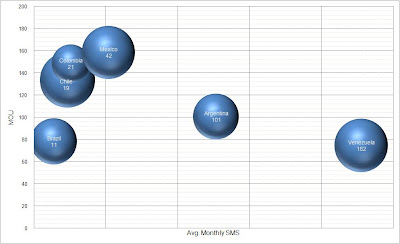
Image
"When we long for life without difficulties, remind us that oaks grow strong in contrary winds and diamonds are made under pressure." ~Peter Marshall Technology companies tend to view the Latin American mobile market as a single block; this might be in part because of the similarities in key demographic and economic factors including language, GDP and mobile penetration as well as the presence of two large players -Telefonica and America Movil- that dominate the region. The Latin American mobile market, however, is incredibly complex. Each country shows remarkably different subscriber usage behavior patterns and adoption of technologies; this translates into different needs and consequently, different opportunities for each market. Opportunity Maps are particularly useful in analyzing and understanding these differences. The chart above shows three key factors: (x) Average Monthly SMS; (y) MOU - Minutes of Usage; and ARPU - Monthly Average Revenue per User (bubble size) for t...

Will 2009 be the year for Mobile Instant Messaging in Latin America?

Image
Subscriber usage behavior clearly shows that the Latin American market is ready for a solution such as GSMA Personal IM, also known as SMS 2.0 (Telefonica Spain, Acision) or Instant SMS (Comverse). The chart above measures three elements: Data ARPU (x), mobile penetration (y) and average number of SMS messages per user per month for several Latin American countries (1) . The countries with SMS usage in the region are Venezuela, Argentina and Ecuador; with Colombia having the lowest SMS usage. These countries also have a higher data ARPU; this is not surprising as in Latin America 70% to 90% of data revenue comes from SMS. What's relevant here is subscriber SMS usage, surpassing 100 messages per user per month as in the case of Venezuela and more recently Argentina; this tells us that heavy users are actually having live conversations using SMS; in other words, a segment of subscribers uses SMS as Instant Messaging, with a higher number of messages going back and forth per conversa...

Can operators generate more revenue from Voice?

With mobile penetration around the world reaching saturation, and the growth rate for traditional services flattening, operators are looking for new options to increase revenue. However, traditional services (voice, SMS) continue to be the main revenue generators for operators and there are still many interesting options to continue milking the cash cow. Services such as Ring Back Tones, MMS and Push e mail, when they were first introduced, created huge expectations that have not been delivered. In addition, operators get distracted by these new services and tend to overlook the basics. Voice mail, for example, is still the main call completion service and SMS continues to be the main messaging service worldwide; it is expected this trend will continue for the next few years. Operators can benefit from looking at options that sit on top of both services, to revitalize them and target missed opportunities. One of the key advantages to leveraging voice and SMS is that they can be used to...

VoiceMail 2.0: Coming soon to Latin America?

Voicemail has been a common service for both wireless and fixed network operators in Latin America for more than 10 years but it has remained essentially unchanged since its introduction. Calls on busy/unavailable/unreachable are transferred to Voicemail , where callers can leave a message. The called party receives a notification, usually by SMS and then dials in, enters a password and listens to recorded messages. Even though vendors like Comverse and Glenayre have had multimedia voicemail solutions for a while now, it was not until AT&T launched the iPhone that services like Visual Voicemail started gaining traction in the end user's perception. This is prompting operators to look into bringing their Voicemail into the 21st century. Even though it is a service that in many countries in Latin America has almost 100% penetration, operators have been slow in updating their Voicemail application. The iPhone's Visual Voicemail interface, however, is changing subscribers...